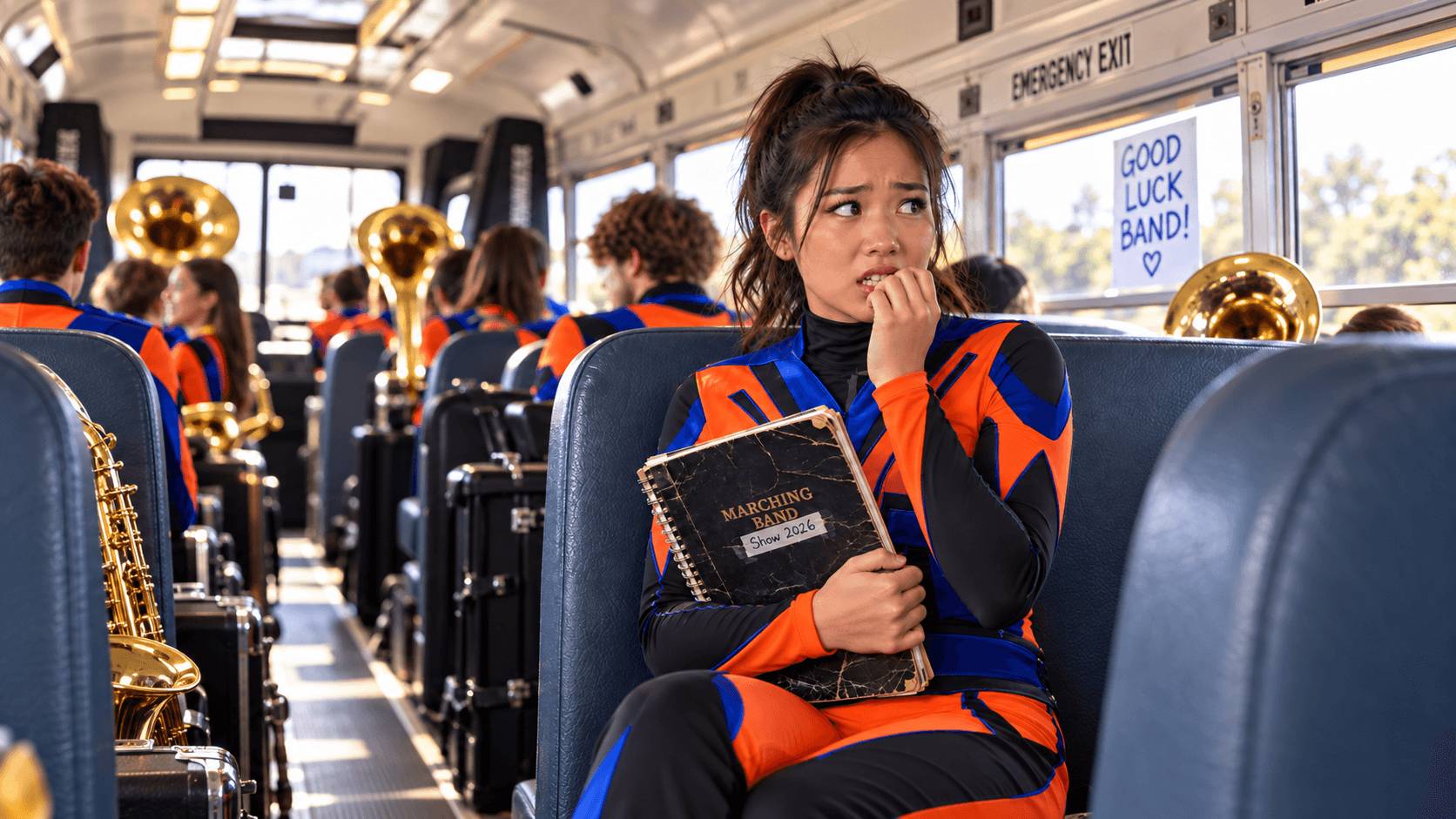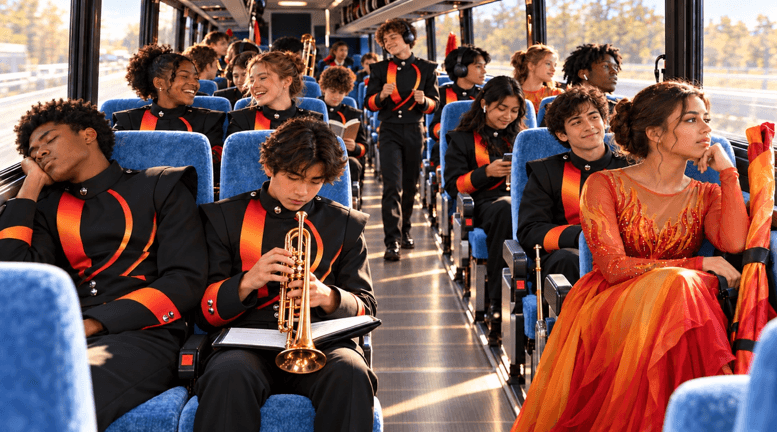
The bus is moving.
People are talking. Someone is laughing three rows behind you. A friend is scrolling through a phone. Maybe somebody is asleep against the window. Your uniform is packed. Your instrument is nearby. Your mind, however, may already be at the stadium.
You may be thinking about the opening set.
The difficult transition.
The solo.
The toss.
The tempo.
The judges.
The score.
The possibility of making a mistake.
And sometimes the hardest part of contest day happens before you ever step onto the field.
It happens inside your own mind.
That is where meditation can help.
So, What Is Meditation?
Meditation is simply the practice of becoming quiet enough to notice what is happening inside you.
It does not have to be complicated.
And it does not have to belong to any particular religion.
Meditation has been used in many religious traditions, but it is also practiced in completely secular settings by athletes, performers, students, musicians, and people who simply want to become calmer and more focused.
You do not have to believe anything special.
You do not have to chant.
You do not have to sit in a strange position.
You do not even have to close your eyes.
For a marching band member on the way to a contest, meditation can be something very simple:
Be still. Breathe. Listen. Notice. Let your mind settle.
That is enough.
Your Mind Is Usually Going Somewhere
Most of us spend a surprising amount of time somewhere other than the present moment.
We think about what happened yesterday.
We imagine what could happen later.
We replay mistakes.
We predict problems.
We create conversations that have not happened.
And on contest day, your mind may travel several hours into the future before the bus has even reached the stadium.
Meditation gently brings you back.
Not to tomorrow.
Not to the awards ceremony.
Not to the score.
Not to the mistake you are afraid you might make.
Back to right now.
The seat underneath you.
The sound of the bus.
Your breathing.
The music in your headphones.
This moment.
And then the next one.
You Are Not Trying to Empty Your Mind
People sometimes think meditation means having absolutely no thoughts.
That is almost impossible.
Your brain is designed to think.
The goal is not to stop every thought.
The goal is to notice a thought without automatically following it.
Suppose this thought appears: What if I miss that entrance tonight?
You do not have to argue with it.
You do not have to answer it.
You can simply notice it.
"There is that worry again."
And then return your attention to your breathing or to the music.
Another thought may arrive.
You notice it.
Then you return.
That simple act of returning is part of the practice.
And there is something very important about that for a performer.
Because marching band asks you to do exactly the same thing.
Something unexpected happens.
You recover.
Your attention wanders.
You return.
You make a small mistake.
You return.
The person beside you has a problem.
You return.
Again and again, great performance depends on the ability to come back to the present moment.
Why Music Can Help
Silence can be difficult when you are nervous.
Music gives the mind somewhere gentle to rest.
A slow orchestral piece can create a kind of emotional space between you and all the noise in your head.
You begin to notice a sustained string chord.
A quiet French horn.
A piano note disappearing into silence.
A soft woodwind melody.
The rise and fall of the harmony.
Instead of listening to your fear, you begin listening to sound.
Music also naturally gives the mind structure.
A melody begins.
It develops.
It breathes.
It resolves.
There is movement without hurry.
For a musician, this can be especially powerful because you already understand how to listen.
You have spent years learning to hear balance, phrasing, color, rhythm, dynamics, and silence.
Meditation with music simply asks you to use those same listening skills inwardly.
Try This on the Bus
Put on your headphones if your director allows them.
Sit comfortably.
You do not need a special posture. Just let your shoulders relax.
Take a slow breath in.
Then breathe out a little more slowly than you breathed in.
Start the music.
For the next five or six minutes, give yourself permission to do absolutely nothing except listen.
Notice the first sound.
Notice where it seems to come from.
Notice when another instrument enters.
Notice how the harmony changes.
If your thoughts wander toward the contest, simply return to the music.
Do not get angry at yourself for becoming distracted.
Return.
Listen.
Breathe.
Let the music move forward without needing anything from you.
For these few minutes, you do not have to improve.
You do not have to impress anyone.
You do not have to win anything.
You simply have to be here.
When the Music Ends
Do not immediately grab your phone.
Give yourself ten more seconds.
Take one final breath.
Look out the window.
And remember this:
You do not need to know exactly what will happen when you step onto the field.
You only need to be present when it happens.
The bus will arrive.
The doors will open.
You will put on the uniform.
You will warm up.
You will hear your name announced.
And eventually there will be that extraordinary little moment before the first sound begins.
For just a second, the entire field seems to wait.
You already know how to meet that moment.
You practiced it here.
Be still.
Breathe.
Listen.
And then—make the first note.