What to Remember on the Bus Ride to the Contest
You can probably feel it already.
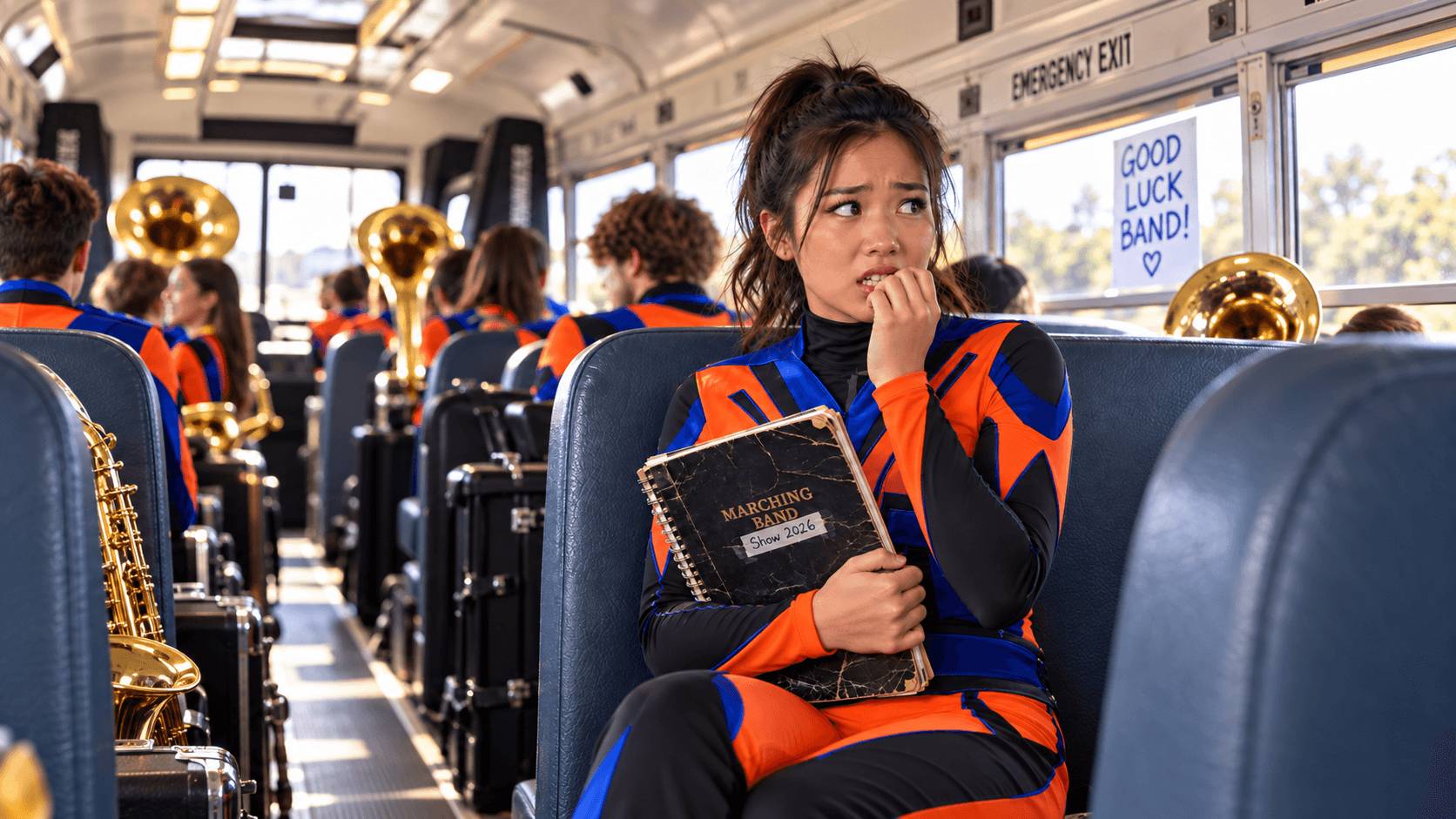
Maybe it is in your stomach. Maybe your hands feel a little colder than usual. Maybe you keep replaying that one measure, that one toss, that one set, that one entrance you are afraid you might miss.
And somewhere in your mind is the question:
What if I mess up?
Here is something worth knowing before you ever step off this bus:
Almost everyone around you is thinking some version of the same thing.
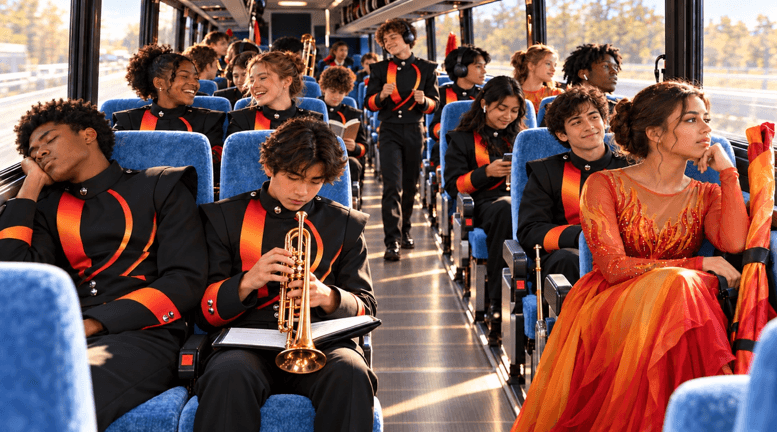
The trumpet player two seats ahead of you may be worried about the high note. The color guard member across the aisle may be thinking about a toss. The snare drummer may be running a difficult passage through his head. The drum major may look completely confident and still be feeling butterflies.
Fear before a performance does not mean you are unprepared.
It usually means you care.
You have spent weeks learning this show. You have rehearsed in the heat. You have repeated the same eight counts until you were tired of hearing them. You have fixed mistakes, adjusted intervals, counted rests, cleaned drill, worked on balance, and heard your director say, "Again," more times than you can remember.
Now the rehearsal part is almost over.
Soon it will be time to perform.
Stop Trying Not to Make a Mistake
One of the worst things you can tell yourself before a performance is:
Don't mess up.
Why?
Because now your brain is searching for everything that could possibly go wrong.
Don't miss the entrance.
Don't step off early.
Don't drop the rifle.
Don't crack the note.
Don't forget the direction change.
Don't be the person everybody notices.
That kind of thinking makes your world smaller and your fear bigger.
Instead, give your brain something useful to do.
Watch the drum major.
Listen across the ensemble.
Breathe.
Count.
Perform through the phrase.
Hit the next set.
Those are things you can control.
You do not perform a ten-minute marching show all at once.
You perform this count.
Then the next one.
Then the next one.
If You Make a Mistake, Keep Going
Here is another truth that experienced performers eventually learn:
You may make a mistake today.
That does not mean you will. But you might.
And if you do, the performance is not over.
A missed note is not the whole show.
A slightly crooked interval is not the whole show.
A late entrance is not the whole show.
Even a dropped piece of equipment is not the whole show.
The important question becomes:
What do you do next?
Great performers recover.
They do not mentally stand beside the mistake staring at it while the rest of the show continues without them.
They return immediately to the present.
The mistake happened two seconds ago.
Those two seconds are gone.
The next two seconds still belong to you.
Use them.
The Audience Does Not Know Your Show Like You Do
You know every detail.
You know exactly where your horn angle is supposed to be. You know exactly where your feet should land. You know the note that your director has corrected twelve times this week.
The audience does not.
They are experiencing the entire production.
They see movement.
They hear music.
They notice energy.
They feel emotion.
A tiny mistake that feels enormous inside your head may barely register to someone sitting fifty rows away.
So do not announce a mistake with your face.
Do not grimace.
Do not shake your head.
Do not suddenly stop performing.
Keep your confidence.
Keep your character.
Keep selling the show.
The Judges Are Not Waiting for You to Fail
It can sometimes feel as though there are people sitting high in the stadium waiting for you to make a mistake.
That is not what this is about.
Judges are evaluating the performance in front of them. They are listening to the ensemble, watching the visual program, considering achievement, communication, consistency, and effectiveness.
They are not sitting there thinking:
I hope somebody messes up.
Your goal is not to hide from the judges.
Your goal is to give them something worth watching and listening to.
Perform toward the audience, not away from the possibility of failure.
Nervous and Excited Feel Surprisingly Similar
Think about what happens when you are nervous.
Your heart beats faster.
You breathe differently.
You feel energy moving through your body.
Now think about what happens when you are excited.
Your heart beats faster.
You breathe differently.
You feel energy moving through your body.
Your body sometimes has trouble telling the difference.
So when the butterflies arrive, try changing the sentence in your head.
Instead of: I'm scared. Try: I'm ready to perform. Instead of: I hope I don't mess up. Try: I can't wait to show them what we built.
That does not magically remove every nervous feeling.
It gives the feeling somewhere useful to go.
Look Around the Bus
Before you arrive, take a moment and look around you.
These are the people who know what it took to get here.
They were at rehearsal when the opener fell apart.
They remember when nobody could make that transition.
They know about the rehearsal when everything finally clicked.
They have sweated beside you, laughed beside you, complained beside you, celebrated beside you, and probably eaten more questionable bus food beside you than anyone should.
You are not walking onto that field alone.
You are part of something larger than yourself.
When one person needs help, somebody else carries a little more.
When somebody has a great moment, the entire ensemble becomes stronger.
That is one of the remarkable things about marching band.
Hundreds of individual decisions become one performance.
When You Step Onto the Field
There will be a moment when all the bus rides, rehearsals, corrections, water breaks, sectionals, and long evenings disappear.
You will hear the stadium.
You will see the lights.
You will find your opening position.
Then there may be a few quiet seconds before everything begins.
Take one good breath.
Feel your feet underneath you.
Look where you have been trained to look.
Trust the people around you.
Trust the work you have already done.
And remember:
You do not have to perform the show perfectly.
You have to perform it fully.
Play with sound.
Move with purpose.
Commit to the moment.
Recover quickly.
Give the audience your energy.
Give your bandmates your attention.
And when the final note ends, make sure you can walk off the field knowing one thing:
You did not spend the performance being afraid of what might go wrong.
You spent it performing what you had worked so hard to make right.
That is courage.
And that is what stepping onto the field is really about.